

 Solitaire
 Hello
Hello
 Paved
Paved
 You and I
 Bezel/Setting
 Vintage
 Three diamonds
 Diamond eternity band
 Other Gems
 Round
Round
 Emerald
 Oval
Oval
 Pear
Pear
 Marquess
 Cushion
 Radiant
 18k White Gold
 18K Yellow Gold
 18K Rose Gold
 18k Yellow Gold and White Gold

July 24, 2026
Choosing a gold piece without knowing what carats mean is like buying wine without understanding the label: you might get lucky, but sooner or later, you'll pay for something that wasn't what you expected. The world of jewelry has its own language, and knowing it makes all the difference between a purchase that lasts a lifetime and a disappointment that ends up forgotten in a drawer.
18-karat gold is, by far, the most common standard in quality fine jewelry. It's found in engagement rings, wedding bands, high-end earrings, and, of course, in the settings that embrace the most meticulously crafted lab-grown diamonds on the market. But what's really behind that number? Why 18 and not 24? How do you know if the gold you're holding or wearing is genuinely 18-karat? This guide answers all of these questions with the depth that an important purchase decision deserves.
What 18-karat gold exactly means
Karat, or carat (both spellings are correct in English), is the unit that measures the purity of gold in an alloy. The scale ranges from 0 to 24, where 24 karats represents 100% pure gold. That said, pure 24-karat gold is almost never used in jewelry, and there are very solid reasons for this.
18-karat gold contains exactly 750 parts of pure gold for every 1,000 total parts of metal, which is equivalent to 75% gold in the alloy. The remaining 25% is composed of other metals, usually copper, silver, palladium, or zinc, which are deliberately incorporated to provide strength, controlled malleability, and, in some cases, to vary the color of the resulting metal. It's not a lower-quality mixture: it's metallurgical engineering designed so that the jewelry can withstand daily use without losing an iota of its value or beauty.
This 75% percentage is so internationally recognized that 18k gold pieces are stamped with the number 750 as a hallmark. If you ever wonder how to tell the karats of gold in a piece you already own, looking for that number inside a ring, on a pendant clasp, or on the inside of an earring is the first step.

Radiant Trilogy Ring in 18k gold
How to reliably determine the karats of gold in a piece of jewelry
Identifying the purity of gold in a piece is not always easy, especially if it's antique jewelry or acquired without certification. There are several reliable methods, and it's good to know them all.
The hallmark or assay mark on 18k gold jewelry
This is the most direct method and the one used by industry professionals as a first reference. In Spain and most European countries, regulations require jewelry to be marked with an assay mark indicating the purity of the metal. For 18k gold, that mark shows the number 750. For 14k gold, you'll see 585; for 9k gold, 375. If the piece has no marking, be wary: it could be a gold plating over another base metal, or directly a lower purity alloy without declaration.
The location of the hallmark varies depending on the type of jewelry. On a ring, it is usually engraved on the inside of the band. On a necklace or chain, on the clasp or the pendant loop. On earrings, on the post or on the back. A jeweler's loupe or even a mobile phone magnifier can help you read it clearly if the characters are very small.
The acid test for identifying gold karats
This is a more technical method, usually reserved for jewelers and appraisers, although home testing kits exist. It involves applying a small drop of nitric acid to the piece, in an inconspicuous area or a notch made with a touchstone, and observing the reaction. Each acid concentration reacts differently depending on the gold percentage. 18-karat gold does not visibly react to standard nitric acid, which confirms its high purity.
This method is minimally destructive, leaves an imperceptible mark, and should be performed with caution. If you lack experience, it's best to consult a trusted jeweler or a certified gemological laboratory.
The magnet test and other basic verifications
Pure gold and its high-grade alloys are not magnetic. If you hold a powerful magnet near a piece supposedly made of gold and it adheres strongly, it's almost certainly not real gold. However, this test has a margin of error: some gold-plated jewelry over steel may show a slight magnetic response due to the steel inside, but the plating itself will not react.
Another basic indicator is weight. Gold is a dense metal. An 18k gold piece has a solidity and weight in hand that imitation alloys cannot easily replicate. It's not a diagnostic method on its own, but combined with other indicators, it provides a fairly clear picture.
Difference between 18k gold and 24k gold in jewelry
This is one of the most frequently asked questions when buying a valuable piece of jewelry and deserves an honest and detailed answer. Many people assume that more karats always equate to better jewelry, and that simplification can lead to wrong decisions.
| Characteristic | 24 Karat Gold (99.9% gold) | 18 Karat Gold (75% gold) |
|---|---|---|
| Purity | Maximum | High (750 parts per thousand) |
| Hardness | Very soft, scratches easily | Resistant for daily use |
| Suitability for jewelry | Limited (decorative or investment pieces) | Ideal for rings, earrings, and necklaces |
| Color | Intense yellow | Variable (yellow, white, pink) |
| Price per gram | Higher | More accessible without losing value |
| Identifying mark | 999 | 750 |
24-karat gold is, in purity, the most valuable. However, its extreme softness makes it impractical for everyday jewelry: it deforms, scratches, and does not hold set gemstones well. A diamond setting in pure 24-karat gold would, in practice, be a risk for the stone. That's why almost no serious jeweler works with it for everyday pieces.
18k gold, on the other hand, offers the perfect balance between metal richness and functionality. It is hard enough to withstand daily wear, noble enough not to cause allergies in the vast majority of people, and pure enough to maintain a solid intrinsic value over time. It is no coincidence that it is the standard of reference in European high jewelry and the metal chosen for setting quality diamonds.

Fancy Vivid Yellow Ring in 18k gold
Why 18-karat gold is the standard for high jewelry with diamonds
If you look at the most renowned pieces of contemporary jewelry, from engagement rings to formal earrings, you'll see that 18k gold appears almost universally. There's a technical reason and an aesthetic reason behind this choice.
From a technical standpoint, diamond settings require a metal with sufficient hardness to keep the settings secure for decades. A poorly secured setting can mean the loss of an irreplaceable gem. 18-karat gold has the necessary rigidity to ensure that prongs, bezel settings, or pavés remain in perfect condition over time, much better than higher purity gold.
From an aesthetic perspective, the 18k gold alloy allows for different metal colors with extraordinary results. 18k white gold, alloyed with palladium or rhodium, provides an elegant coolness that enhances the transparency of diamonds. 18k rose gold, alloyed with copper, offers a romantic warmth that has become synonymous with contemporary femininity. And classic 18k yellow gold regains its full strength as a symbol of tradition and timeless luxury.
At The Bright Club, we work exclusively with 18-karat gold to ensure that every lab-grown diamond that enters our pieces is set with the security and elegance it deserves. The combination of a lab-grown diamond with an 18k gold setting is not a concession: it is the smartest and most ethical choice you can make.
Colors of 18-karat gold and how to choose the most suitable one
One of the aspects that most confuses newcomers to the world of fine jewelry is understanding that the color of gold does not depend on its purity, but on the metals with which it is alloyed. Understanding this will help you choose with much more informed judgment.
- 18k yellow gold: This is the most classic and recognizable form. The alloy maintains the characteristic warm, golden tone of the metal thanks to the presence of copper and silver in balanced proportions. It is timeless, goes with all types of stones, and has a very defined visual presence.
- 18k white gold: It is achieved by alloying gold with silver-toned metals such as palladium. It usually receives a rhodium plating that intensifies its whiteness and gives it extra surface hardness. It is a favorite for diamond engagement rings because it maximizes the stone's luminosity.
- 18k rose gold: The higher proportion of copper in the alloy results in that warm, rosy tone so popular in contemporary jewelry. It is versatile, flattering for different skin tones, and provides a romantic character without being garish.
The choice between one and the other fundamentally depends on your personal style, your skin tone, and how you want the stone to be the star of the piece. A lab-grown diamond with a brilliant cut, for example, sparkles differently on white gold than on yellow gold, and both options are equally valid: they simply convey different feelings.
How to care for 18-karat gold jewelry so it lasts a lifetime
18k gold is resistant, but not invulnerable. Keeping your jewelry in perfect condition over time requires some simple habits that make a huge difference.
- Remove your gold jewelry before activities that involve exposure to harsh chemicals: swimming pools with chlorine, household cleaning products, perfumes sprayed directly onto the piece.
- Store them in separate compartments to prevent them from rubbing against each other. 18k gold, although resistant, can scratch with other metal pieces.
- Clean your jewelry periodically with lukewarm water, a few drops of mild soap, and a very soft-bristled brush. Dry them well before storing.
- Take your pieces to a trusted jeweler from time to time for a professional review, especially if they have set gemstones. A re-rhodium plating for white gold and a check of the settings ensure everything stays in place.
The long-term value of 18-karat gold as a jewelry investment
Beyond aesthetic beauty, an 18k gold piece of jewelry has real intrinsic value. 75% of its weight corresponds to a metal with a globally recognized market price. This means that, unlike plated jewelry or fashion costume jewelry, an 18k gold piece retains part of its economic value regardless of how much time passes.
This is not about turning your jewelry into a vehicle for speculative investment; for that, other financial instruments exist. Rather, it's about understanding that the quality of the material you choose matters. When you buy an engagement ring, earrings for a special occasion, or a pendant you want to bequeath to someone, 18k gold gives you the assurance that you are not buying something that will degrade over time or lose all its value in a few years.
At The Bright Club, we opt for lab-grown diamonds precisely because they combine that same philosophy: maximum ethical, chemical, and optical quality, at a more accessible price than mined diamonds, and with the same intrinsic value of the four Cs that any certified gemologist can verify. Set in 18-karat gold, the result is a piece of jewelry that rivals those from major high-jewelry houses, and that you can wear with the pride of having chosen well.

Gabriela Melguizo
Founding Partner & Brand Director
Learn more

Rivière: what it means and what's special about this jewel
Rivière is a French word meaning "river." In jewelry, it refers to a specific design: a continuous succession of aligned gemstones that form a fluid line of light. It applies to both necklaces and ...
Read more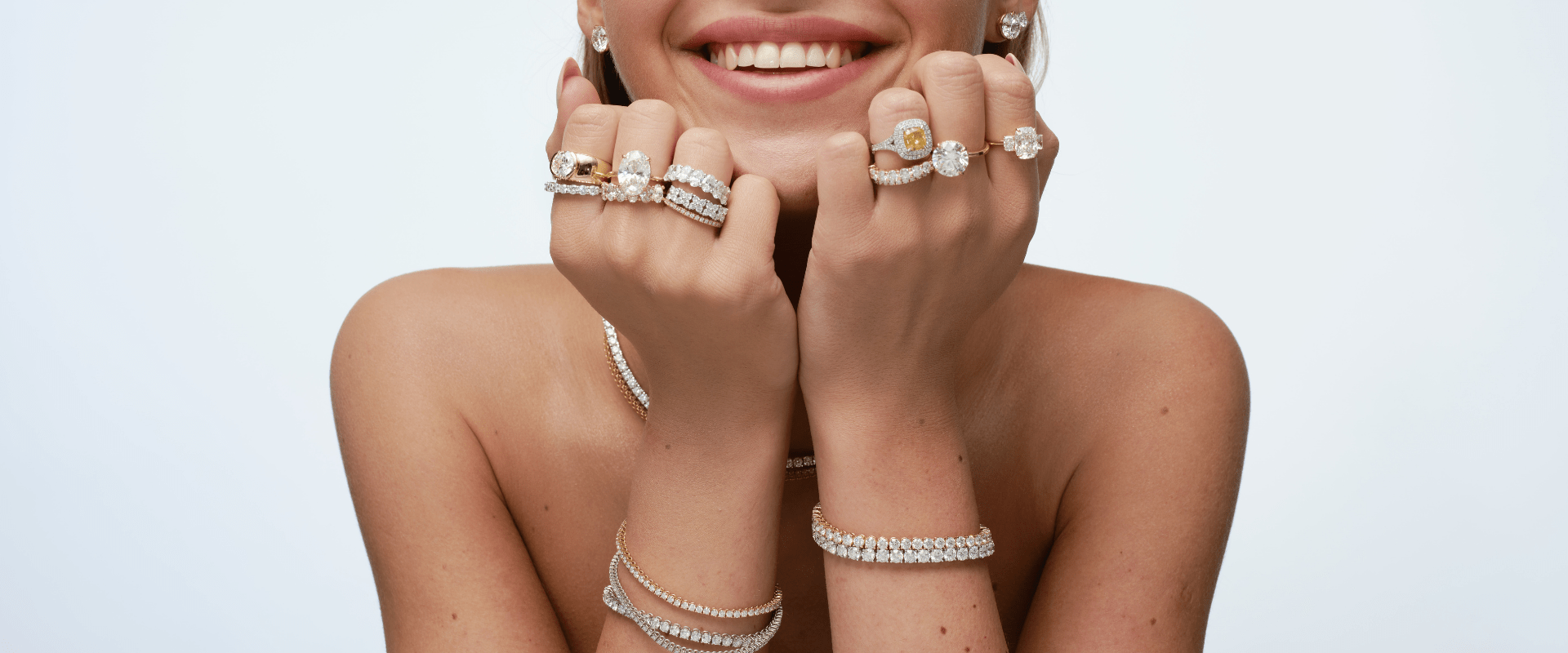
The best wedding anniversary gift that lasts forever
There are anniversaries celebrated with a special dinner, others with a spontaneous trip, and some with a gift cherished for a lifetime. Jewelry is that kind of gift: a beautiful way to mark a stag...
Read more
