

 Solitaire
 Hello
Hello
 Paved
Paved
 You and I
 Bezel/Setting
 Vintage
 Three diamonds
 Diamond eternity band
 Other Gems
 Round
Round
 Emerald
 Oval
Oval
 Pear
Pear
 Marquess
 Cushion
 Radiant
 18k White Gold
 18K Yellow Gold
 18K Rose Gold
 18k Yellow Gold and White Gold


April 13, 2026
Quick answer: In Spain, the engagement ring is worn on the ring finger of the right hand. On the wedding day, it is moved to the left hand, and the wedding band occupies the right hand. There are exceptions in Catalonia, the Valencian Community, and the Balearic Islands, where the tradition is the opposite.
Before choosing the perfect ring, one of the first questions that arise is where exactly it goes. And it makes sense: it's a piece of jewelry you'll wear every day, that will tell your story, and that, depending on your stage of life, will change hands. In this guide, I'll tell you everything you need to know to clear up any doubts.
Why the engagement ring goes on the ring finger
The ring finger gets its name precisely because it is the finger on which the engagement ring is placed. This is the tradition in Spain and most European countries, as part of a cultural and symbolic heritage from the Roman Empire.
The tradition of wearing the engagement ring on the ring finger dates back to Ancient Rome. Romans believed in the existence of the Vena Amoris, a supposed vein that directly connected the ring finger to the heart, a universal symbol of love. Although today we know that this specific vein does not anatomically exist, the romantic idea persisted for centuries and was adopted by different European cultures.
But the Roman tradition is not the only one that points to the ring finger as the place of love. In China, there is also a belief in the relationship between this finger and love: the ring finger represents the couple's relationship, the thumb symbolizes the parents, the index finger would represent siblings, the middle finger ourselves, and the little finger, the smallest, the children.
There is also an explanation linked to Catholicism. When Christianity emerged, priests had the custom of touching the fingers while reciting a prayer: "in the name of the Father" (they touched the thumb), "of the Son" (they touched the index finger), "and of the Holy Spirit" (they touched the middle finger), and "Amen" finally reaching the ring finger, thus sealing the union.
Which hand does the engagement ring go on in Spain?
This is, without a doubt, the most common question. And the answer has important nuances depending on the region of the country.
General tradition in Spain
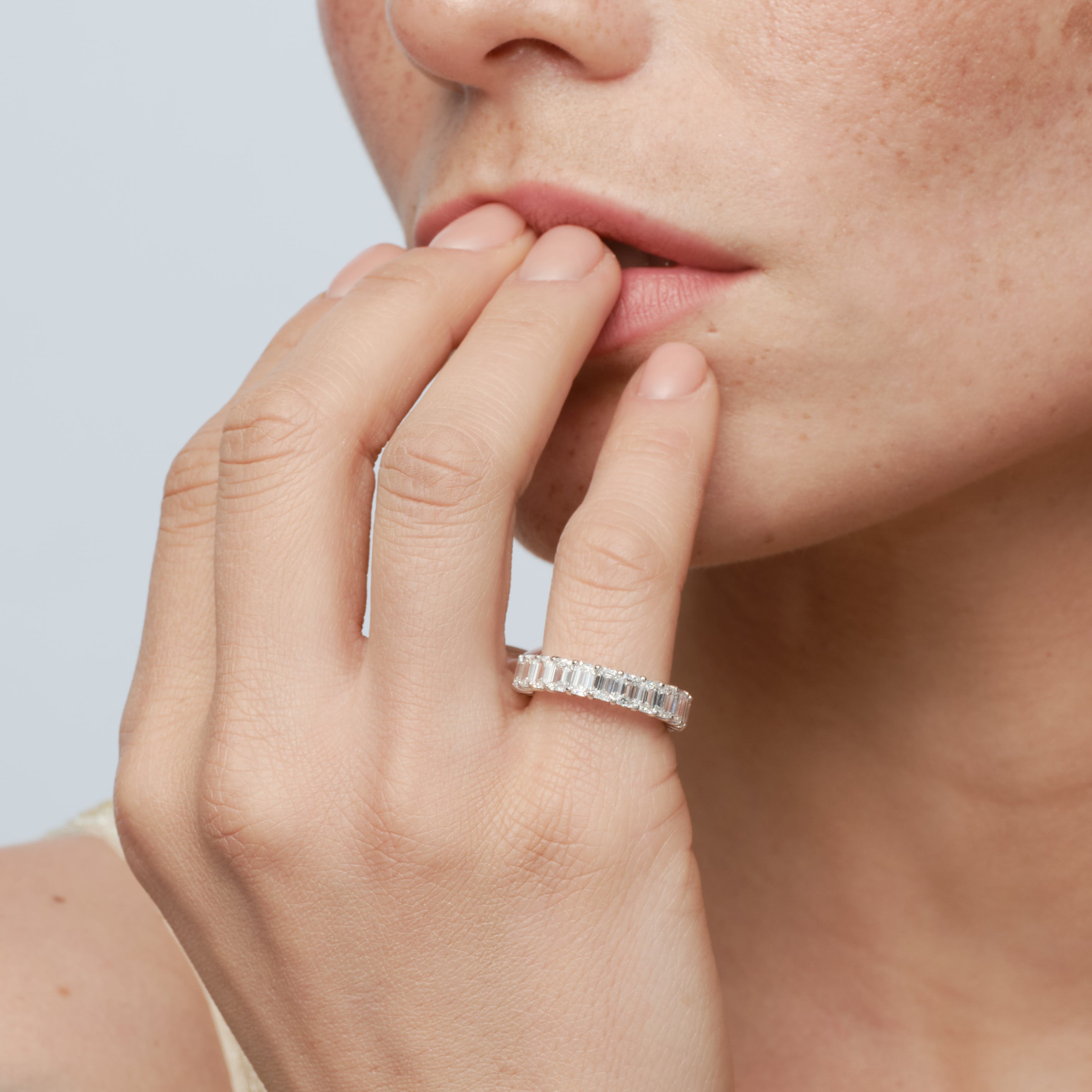
In most of Spain, the engagement ring is worn on the ring finger of the right hand. On the wedding day, it is moved to the ring finger of the left hand, and the wedding band then occupies the right hand. This exchange symbolizes the transition from engagement to marriage.
The reason for placing it on the right hand comes from Catholic tradition, as it is believed that the right hand represents righteousness and fidelity.
Regional exceptions: Catalonia, Valencia, and the Balearic Islands
In the Mediterranean area, Catalonia, the Balearic Islands, and Valencia, the custom is the opposite: the hand on which the engagement ring is placed is the left. After the wedding, the engagement ring remains on the left hand, and the wedding band moves to the right hand.
Summary by regions
|
Region |
Engagement Ring (before wedding) |
Engagement Ring (after wedding) |
Wedding Band |
|
Spain (general) |
Right hand, ring finger |
Left hand, ring finger |
Right hand, ring finger |
|
Catalonia, Valencia, Balearic Islands |
Left hand, ring finger |
Left hand, ring finger |
Right hand, ring finger |
What happens to the engagement ring on the wedding day
This is one of the moments that causes the most doubt. Do you take it off? Do you switch hands? Do you wear it during the ceremony?
The predominant tradition in Spain is clear: the engagement ring is worn on the right hand until the day of the wedding. After the exchange of wedding rings during the ceremony, the engagement ring is moved to the left hand, and the wedding band occupies the ring finger of the right hand.
However, more and more couples are opting for alternatives:
-
Wearing both rings on the same hand: the engagement ring and the wedding band together on the right ring finger.
-
Keeping each ring on its original hand: the engagement ring on the right and the wedding band on the left, giving each piece of jewelry its own symbolic space.
-
Stacking both rings: a very popular trend today, especially when the engagement ring is designed to fit perfectly with the wedding band.
In recent years, an alternative that continues to gain followers has emerged: many people prefer to keep both rings on their hand. At the time of the wedding, they wear the engagement ring as a symbol of excitement for that day, and when the exchange takes place, the wedding ring is added.
Engagement ring and wedding band on the same finger: how to combine them?
If you decide to wear both on the same finger, there are some practical aspects to consider before choosing the design of your engagement ring:
-
The ring's profile matters: very high settings or designs with side pavé can make it difficult for the wedding band to sit properly.
-
Bridal sets are designed for this: many engagement rings are created with a matching wedding band that fits perfectly beside them, without gaps or rubbing.
-
The stacking order: the wedding band is usually placed closer to the palm, and the engagement ring on top. This helps the wedding band to be "protected" by the engagement ring.
The engagement ring for men: which hand does it go on?
The question about men's engagement rings is increasingly common, and rightly so: equality in commitment is a reality that many couples proudly embrace.
In Spain, a man's engagement ring is placed on the ring finger of the left hand. There is no strict rule, but by tradition or comfort, many men follow the same cultural customs as women. Some prefer to wear it as a discrete signet ring or even on a chain around their neck, especially if their job makes it difficult to wear rings.
More and more men are adopting the custom of wearing engagement rings, and for same-sex couples, there are no fixed rules: the finger and hand are chosen freely, with the personal and unique meaning of each union prevailing.
The engagement ring around the world: how it varies by country
The Spanish tradition is not universal. Knowing how the engagement ring is worn in other countries can be very useful if you are getting married abroad or are simply curious culturally.
|
Country / Region |
Engagement ring hand |
Wedding band hand |
|
Spain (general) |
Right |
Right |
|
Catalonia / Valencia / Balearic Islands |
Left |
Right |
|
USA / UK / France |
Left |
Left |
|
Germany / Austria / Norway / Russia |
Right |
Right |
|
Greece / Ukraine / Eastern Europe |
Right |
Right |
|
Brazil / Argentina / Chile |
Right → moves to left after wedding |
Left |
|
India |
Varies by region and religion |
Right |
In most Western countries, including the United States, United Kingdom, France, and Italy, the ring is placed on the ring finger of the left hand. This tradition is the most widespread and recognized worldwide, especially in the Anglo-Saxon world.
In Germany, Austria, Norway, Poland, and Russia, the engagement ring is worn on the ring finger of the right hand, a deeply rooted custom in their culture. In Greece and other Eastern European countries, the right hand is also preferred, with roots in the Orthodox Church, where the right hand is considered more symbolically important.
The historical origin of the engagement ring
Understanding where this tradition comes from helps to give even more value to the gesture. The history of the engagement ring is much longer than you imagine.
These rings are a symbol of eternal love that dates back to Egypt approximately 4,800 years ago. The circle, without beginning or end, symbolizes eternity, while the central void represents a gateway, that is, the union.
In the Roman Empire, wedding bands became more sophisticated and began to be made of iron. It was believed that a ring of this hard material invoked the god Saturn and symbolized the strength and solidity of the couple.
It wasn't until the 13th century when, under the influence of Pope Innocent III, the tradition of first giving an engagement ring and, months later, exchanging the definitive wedding band was established. This was done to give prospective fiancés time to reflect before uniting in marriage.
Over the centuries, what began as a symbol of ownership transformed into what it is today: one of the most beautiful expressions of love and the free and mutual commitment between two people.
Difference between an engagement ring and a wedding band
These are two distinct pieces of jewelry with distinct meanings, and it's important to be clear about them before making design decisions.
|
Engagement Ring |
Wedding Band |
|
|
When is it given? |
At the proposal |
During the wedding ceremony |
|
Who wears it? |
Traditionally only her, though more and more men also wear one |
Both partners |
|
Typical design |
With a central stone, usually a diamond |
Plain band or with small details |
|
Meaning |
Promise of future marriage |
Definitive marital union |
|
Hand in Spain |
Right (before wedding) → left (after) |
Right |
How to measure the finger for the engagement ring
If you're planning a surprise proposal, this section is particularly important. Choosing the correct ring size is essential for that moment to be perfect.
Practical tips for getting the size right:
-
The borrowed ring trick: if your partner has a ring they habitually wear on their ring finger, you can borrow it (or take it to a jeweler) to measure the inner circumference.
-
Paper and pen: wrap a strip of paper around your partner's ring finger while they sleep or discreetly, mark the closing point, and measure the length. This measurement corresponds to the finger's perimeter.
-
Ask their inner circle: friends, sisters, or their mother usually know the size or can help you find out without raising suspicion.
-
Right and left ring fingers are not always the same: the dominant finger tends to be slightly thicker, so consider which hand the ring will be worn on.
-
Temperature affects: fingers tend to swell with heat and shrink with cold. Ideally, measure under neutral conditions, at room temperature.
-
If you're unsure, choose a larger size: it's much easier to reduce a ring than to enlarge it.
Ideas for the proposal: the moment to present the ring
The engagement ring is the star, but the moment it is presented also matters. Here are some ideas to make that moment unforgettable:
At home:
-
Decorate the space with candles and flowers, play your song, and create the perfect atmosphere in the intimacy of your home.
-
Hide the ring in a special place and organize a "treasure hunt" with clues about important moments in your history.
-
Prepare a homemade dinner with their favorite dishes and propose at the end.
At a restaurant:
-
Coordinate with the restaurant to place the ring in the dessert or inside a champagne glass.
-
Choose a place with special meaning for you: where you had your first date, where you met.
-
Notify the staff so they can help you capture the moment in a photo.
On the beach or in nature:
-
Write the question in the sand and wait for them to discover it.
-
Organize a picnic in your favorite outdoor spot.
-
Take advantage of a special sunset to create the perfect moment with natural light as your ally.
Surprise proposals:
-
Involve friends and family if you know your partner would love to share it.
-
Hire a photographer or videographer to capture the moment without them knowing.
Create a video with memories of your relationship and ask her to marry you at the end.
The most important thing is that the moment represents you as a couple. There is no perfect formula: there is the one that is perfect for you.
FAQs about the engagement ring
In most of Spain, on the ring finger of the right hand. In Catalonia, Valencia, and the Balearic Islands, the tradition is to wear it on the left hand.
Always on the ring finger, on either the right or left hand, depending on regional or personal tradition.
In Spain, it's common to switch the engagement ring to the left hand on the wedding day, leaving the right hand free for the wedding band. It's also possible to wear it on the same finger as the wedding band or keep it on its original hand.
More and more men are choosing to wear it. In Spain, if worn, it is usually placed on the ring finger of the left hand, although there are no strict rules about it.
Yes. It is a very popular choice. In this case, the wedding band is usually placed closer to the palm and the engagement ring on top. It is recommended that both pieces are designed to complement each other.
It is not mandatory, but diamonds are by far the most popular choice for engagement rings due to their hardness, brilliance, and symbolism of eternity. Today, lab-grown diamonds offer exactly the same physical, chemical, and optical properties as earth-mined diamonds, with the advantage of being a more sustainable and accessible choice.
There's no real rule about this. The famous "two months' salary" rule is a myth popularized by marketing campaigns. The important thing is to choose a piece of jewelry that is meaningful to you and that fits your budget. Diamond quality, metal type, and design are the factors that most influence the price.
They are exactly the same. "Anillo de pedida" and "anillo de compromiso" are two terms that are used interchangeably in Spanish to refer to the same piece of jewelry.
Learn more
How to Determine Your Ring Size: The Ultimate Guide with All the Methods
Quick answer: To find your ring size, measure the circumference of your finger with a tape measure or a strip of paper and a ruler, or measure the inside diameter of a ring that already fits you we...
Read more
Men's engagement rings and how to choose the right one
The tradition of men's engagement rings is changing. What was once considered exclusively feminine, is now an essential part of modern marriage proposals, where both members of the couple wear a pi...
Read more
