

 Solitaire
 Hello
Hello
 Paved
Paved
 You and I
 Bezel/Setting
 Vintage
 Three diamonds
 Diamond eternity band
 Other Gems
 Round
Round
 Emerald
 Oval
Oval
 Pear
Pear
 Marquess
 Cushion
 Radiant
 18k White Gold
 18K Yellow Gold
 18K Rose Gold
 18k Yellow Gold and White Gold


April 17, 2026
Quick answer: a diamond is the gemstone; brilliant is the cut. A brilliant is, in fact, a diamond that has been given a round shape with 57 or 58 facets to maximize its light reflection. Therefore, all brilliants are diamonds, but not all diamonds are brilliants.
If you've ever walked into a jewelry store and left with more questions than you had going in, you're not alone. The terms "diamond" and "brilliant" are often used interchangeably, as if they were synonyms, but they are not. Knowing the difference not only makes you more knowledgeable on the subject; it helps you make better decisions when buying a piece of jewelry you'll wear for a lifetime.
What is a diamond?
A diamond is a mineral formed by carbon atoms crystallized under extreme pressure and temperature deep within the Earth. It is the hardest natural substance known, a 10 on the Mohs scale, and one of the most valued gemstones in the world.
When extracted from the earth, a diamond has an irregular, unpolished shape. In that state, it is called a rough diamond. To transform it into the stone we see in diamond jewelry, it needs to undergo a cutting and polishing process.
Today, diamonds are not only sourced from the earth. Lab-grown diamonds are created by replicating the same pressure and temperature conditions that give rise to natural diamonds in a controlled environment. The result is a stone with exactly the same physical, chemical, and optical properties, certified by the same international gemological laboratories and cut to the same precision standards.
What is a brilliant?
A brilliant is not a stone. It is a cut, that is, a specific way of cutting and polishing a diamond. Its full name is brilliant cut diamond, although in everyday language it has been simplified to just "brilliant."
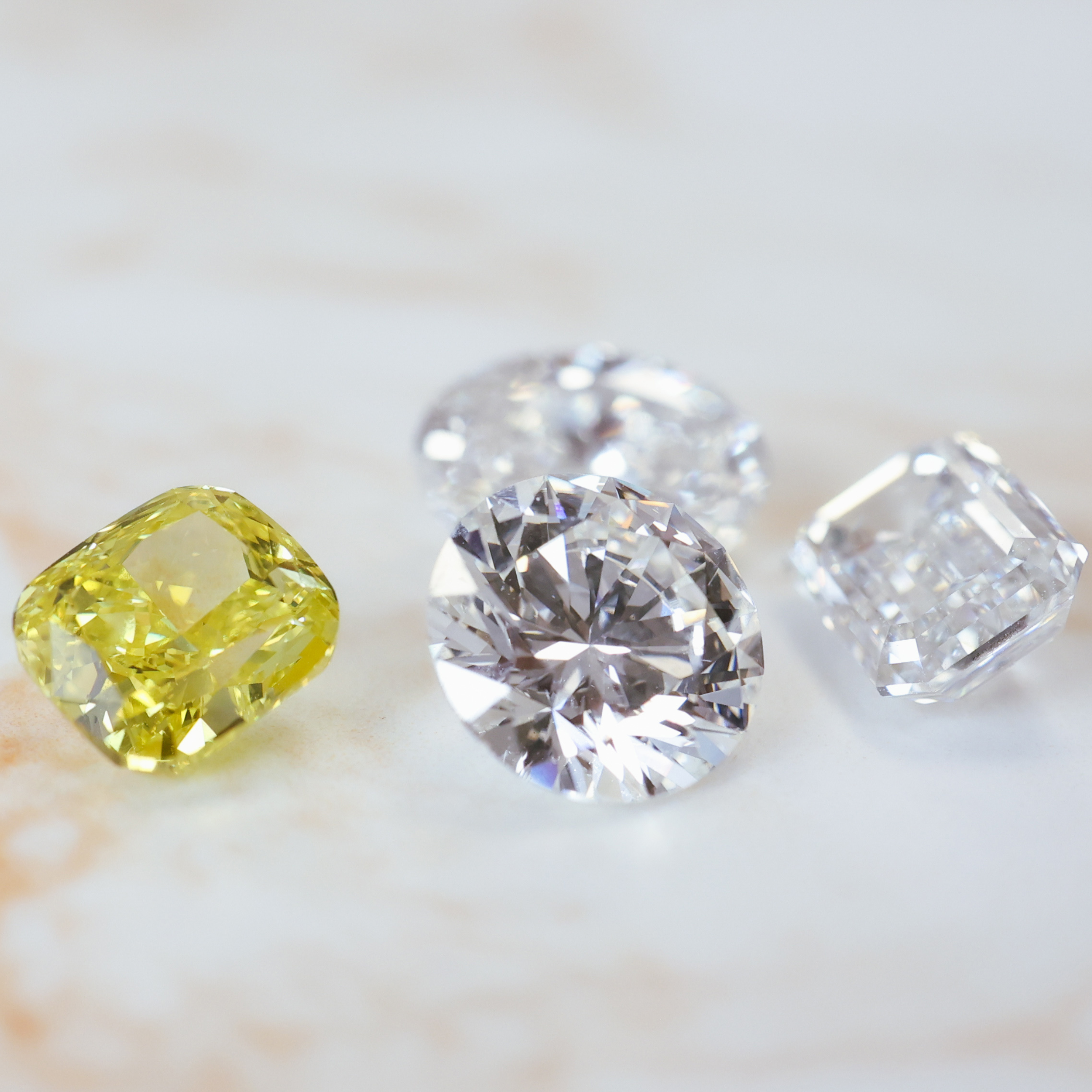
This cut is characterized by its round shape and 57 or 58 facets, depending on whether it ends in a point or with a small flat facet at the base called a culet. Each of these facets is precisely calculated so that the light entering through the top of the diamond reflects internally and exits, projecting the maximum possible brilliance.
An important clarification: technically, the brilliant cut can be applied to other gemstones such as sapphire, ruby, or emerald. However, in jewelry, there is an established convention: when only the word "brilliant" appears in the characteristics of a piece, without specifying the stone, it always refers to a diamond.
The real difference between brilliant and diamond
Here's the summary that clarifies everything:
|
Diamond |
Brilliant |
|
|
What is it? |
A gemstone |
A way of cutting that stone |
|
Are they the same? |
Not exactly |
A brilliant is always a diamond |
|
Are they all alike? |
No, there are multiple cuts |
It is a specific cut: round, 57-58 facets |
|
Which is worth more? |
Depends on the 4Cs, not the term |
The cut adds value to the rough stone |
In summary: the diamond is the raw material, and the brilliant is the result of applying the most valued and popular cut of all to it. When someone says "they are wearing a brilliant," they are saying they are wearing a diamond with a brilliant cut.
Why the brilliant cut is the most popular
It's no coincidence that the brilliant cut is, by far, the most used in jewelry. It was developed and perfected throughout the 20th century with a very specific goal: to make the diamond shine as much as possible.
The arrangement of its 57 or 58 facets is designed so that light enters through the crown, reflects off the pavilion, and exits again through the top in the form of flashes. If the proportions are correct, the result is that characteristic play of light that makes a brilliant catch the eye from any angle.
When the proportions are not ideal, light escapes through the sides or bottom of the stone, and the diamond loses much of its brilliance. That's why the quality of the cut is one of the most important variables when valuing a diamond, whether it is natural or lab-grown.
Other diamond cuts
The fact that the brilliant cut is the most common does not mean it is the only one. There is a wide variety of cuts, each with its own character and appeal. The most recognized are:
Princess cut: square, with many facets and brilliance very similar to that of the brilliant cut. It is the second most popular cut for diamond rings.
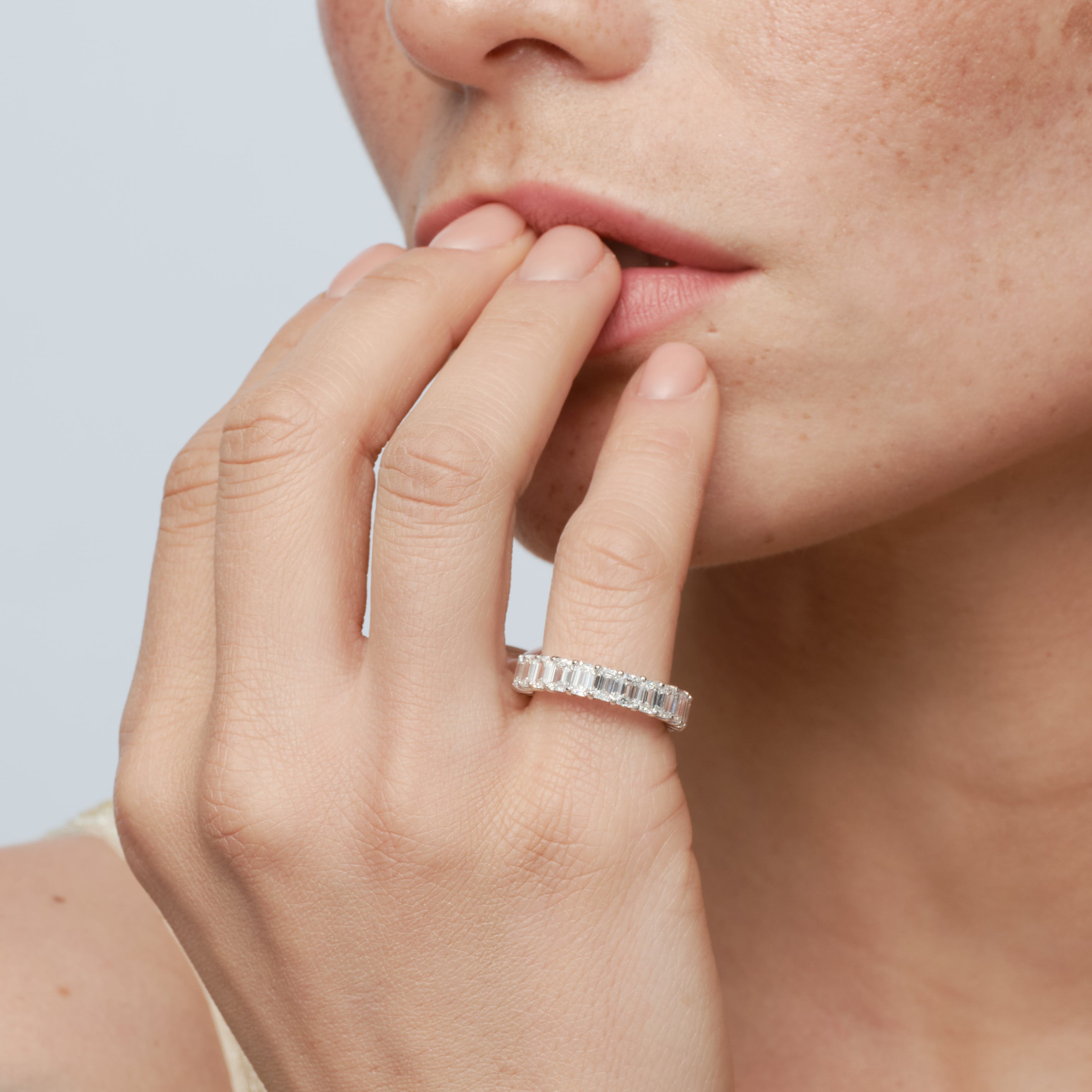
Emerald cut: rectangular, with wider facets arranged in steps. It offers a cleaner and more elegant appearance, although it reflects less light than the brilliant cut.
Oval cut: elongated and rounded, with brilliance very close to that of the brilliant. Visually, it makes the finger appear more slender.
Marquise cut: with two pointed ends and a boat shape. One of the cuts that best utilizes the weight of the stone, making the diamond appear larger than it is.
Pear cut: a combination of brilliant and marquise, with one rounded end and one pointed end. Very elegant in pendants and earrings.
Cushion cut: square or rectangular with rounded corners, with a more classic and vintage look.
Heart cut: the most symbolic of all, it requires a good-sized diamond for the shape to be properly appreciated.
Each cut has its own ideal proportions, its way of interacting with light, and its aesthetic personality. Choosing one or the other is a decision that goes beyond brilliance: it also has to do with the style of the person wearing it.
Which is worth more: a diamond or a brilliant?
This is one of the questions that generates the most confusion, and it has a clear answer: they are not comparable, because a brilliant is a type of diamond.
What determines the price of any diamond, regardless of its cut, are the so-called 4Cs:
Color: diamonds are graded on a scale from D to Z. D corresponds to a completely colorless diamond, the most valued. As we move up the scale, the diamond acquires yellowish tones that reduce its value.
Clarity: refers to the internal and external imperfections of the diamond, called inclusions and blemishes. The fewer imperfections, the higher the clarity and, therefore, the price.
Cut: the quality of the cut determines how much light the diamond is able to reflect. An excellent cut can make a moderately quality diamond sparkle much more than a higher quality but poorly cut one.
Carat: the weight of the diamond is measured in carats. One carat equals 0.20 grams.
Having said all that, a rough diamond will always be worth less than that same diamond after it has been cut and polished. The cutting work adds value, and the more perfect the execution, the higher the final price.
Lab-grown diamond with brilliant cut: the best of both worlds
A lab-grown diamond is, for all gemological purposes, a diamond. It is formed from pure carbon, has the same crystalline structure, the same hardness, and the same brilliance as a diamond extracted from the earth. The only difference is its origin: instead of forming over millions of years under the Earth's crust, it is created in a controlled environment that replicates those same pressure and temperature conditions.
And just like natural diamonds, lab-grown diamonds are cut following exactly the same precision criteria. The brilliant cut is also the most chosen for lab-grown diamonds, for the same reason it is for natural ones: no other cut better utilizes light or projects a more intense brilliance.
The most relevant difference for someone considering buying one is the price. A lab-grown diamond with a brilliant cut offers the same optical properties, the same gemological certificate, and the same visual result as its natural counterpart, but is up to more than 80% more economical. This allows, for example, choosing a larger carat or higher clarity stone at a much better price.
FAQs about the difference between brilliant and diamond
They are not comparable terms: a brilliant is a diamond with a specific cut. The quality of both depends on the 4Cs, not on the name by which they are called.
Not exactly. The brilliant cut can be applied to other gemstones. However, in jewelry, when the term "brilliant" is used without specifying the stone, it always refers to a diamond.
A brilliant has 57 or 58 facets, depending on whether the base ends in a point or with a small flat facet called a culet.
Precisely because it's the cut that maximizes a diamond's brilliance. Its name perfectly reflects what it achieves.
In terms of light reflection, yes: the brilliant cut extracts the most sparkle from a diamond. However, the choice of cut also depends on aesthetic taste and the type of jewelry in which the stone will be set.
It makes no sense to compare prices in that way. The price of a diamond depends on its characteristics: carat weight, color, clarity, and cut quality. An excellent quality brilliant cut diamond can cost much more than a rough diamond, precisely because the cutting process adds value.
Yes, completely. A lab-grown diamond is a diamond in every sense of the word: same composition, same hardness, same brilliance. If cut into a brilliant shape, the result is a full-fledged certified brilliant.

Gabriela Melguizo
Founding Partner & Brand Director
Learn more
How are lab-grown diamonds made
When someone discovers that lab-grown diamonds exist, the next question almost always comes immediately: how are they made? It's a great question, because understanding the process helps to underst...
Read more
All the types of diamonds that exist and how to choose the right one for you
Choosing a diamond is one of the most significant decisions a person can make. It's not just a purchase, but a statement: of love, values, and personal taste. However, when one enters the world of ...
Read more
