

 Solitaire
 Hello
Hello
 Paved
Paved
 You and I
 Bezel/Setting
 Vintage
 Three diamonds
 Diamond eternity band
 Other Gems
 Round
Round
 Emerald
 Oval
Oval
 Pear
Pear
 Marquess
 Cushion
 Radiant
 18k White Gold
 18K Yellow Gold
 18K Rose Gold
 18k Yellow Gold and White Gold


August 12, 2026
There's something about a diamond that captures the eye. It's not just its size or transparency, but that play of light that appears within the stone. The explanation lies in something very specific and precise: the facets of the diamond. These small, flat, polished faces, precisely crafted, are what make a stone go from being merely acceptable to truly special.
Understanding how facets work is understanding why a diamond sparkles the way it does. And understanding it will also help you make more informed decisions when choosing a piece of jewelry.
What are diamond facets?
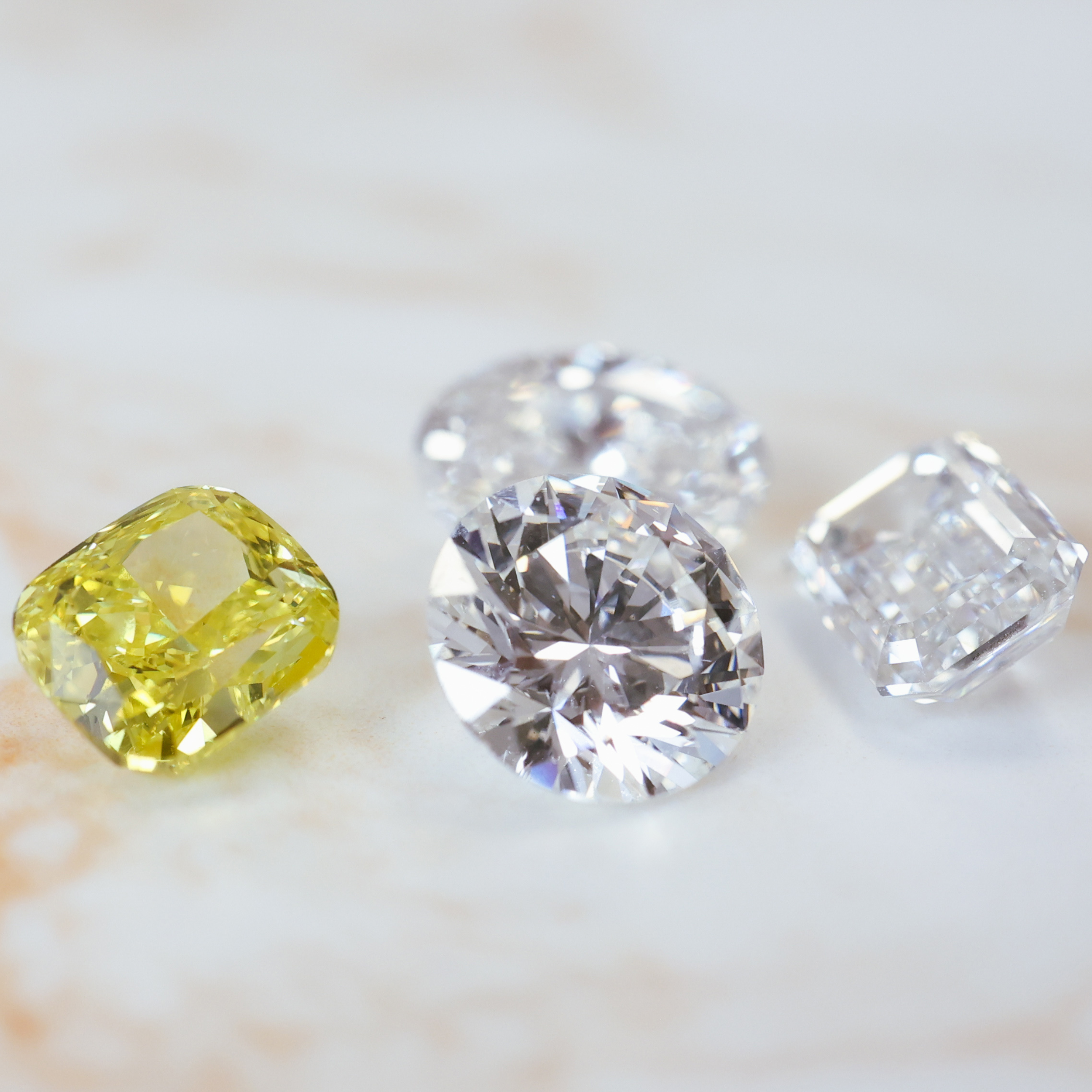
A facet is each of the flat, polished surfaces cut onto the rough stone. They are not just decorative; they have a very specific function. Their angle, size, and position determine how light enters the diamond, how it moves within, and how it exits back to the observer's eye.
The cutter works with great precision because any deviation in a facet's angle affects the final result. It's not enough for them to be well-polished; they must be well-oriented. A diamond with perfectly executed facets can make much better use of light; one with poorly calculated facets, no matter how large or pure, loses some of its brilliance.
Each facet also has a name and a function within the whole. The table, which is the largest and flattest top facet, is the primary entry point for light. The crown facets, the upper part of the diamond, capture and distribute that light. The pavilion facets, the lower part, reflect it back upwards. The whole is, in essence, a hand-designed optical system.
Why diamonds sparkle thanks to their facets
The short answer is: due to refraction and total internal reflection. But it's worth understanding it well.
When a ray of light enters a diamond through its table, it doesn't pass straight through the stone. It bends, it refracts, because the diamond has a very high refractive index (around 2.42). This means that light changes direction much more sharply than in glass or quartz. Once inside, if the angles of the pavilion facets are well-calculated, the light cannot escape through the bottom; it bounces from facet to facet until it exits through the top, back to the observer.
This phenomenon is called total internal reflection, and it is responsible for that intense sparkle that defines a well-cut diamond. But there's more: when white light breaks down as it passes through the diamond, it separates into its different wavelengths, and flashes of color appear (blue, red, green, orange). This effect is known as fire or dispersion, and it also depends directly on the facets and their angles.
Dispersion and fire, along with the sparkle itself, are what make a diamond change so much depending on the light. And all of this is the direct result of the number, shape, and orientation of its facets.
How many facets does a diamond have depending on its cut?
Not all diamonds have the same number of facets. It depends directly on the chosen cut. Some cuts prioritize brilliance and dispersion, requiring more facets and more complex geometries; others opt for elegance and visual depth, with fewer but larger facets.
The following table summarizes the main cuts and their number of facets:
| Cut | Number of facets | Main characteristic |
|---|---|---|
| Round brilliant | 57-58 | Maximum brilliance and dispersion |
| Princess | 74 | Intense sparkle in a square shape |
| Oval | 55 | Similar brilliance to round, elongated shape |
| Cushion | Variable (57-64) | High fire, softened edges |
| Emerald | 57 | Elegance and depth, less fire |
| Marquise | 55 | Elongated silhouette, great visual presence |
| Pear | 56 | Hybrid shape, very stylized |
| Baguette | 25 | Clean lines, architectural character |
| Triangle | 19 | Minimalism and modernity |
As you can see, the difference between a round brilliant cut with 57-58 facets and a baguette with 25 is enormous. This difference is not arbitrary; it responds to the optical philosophy of each cut. The baguette does not aim to compete in intense brilliance with the round; it seeks visual cleanliness, geometric lines, and a more understated elegance.
The round brilliant cut and its mastery of light
The round brilliant cut deserves its own section because it is one of the most studied and optimized cuts in history. Its 57 or 58 facets, depending on whether or not it includes the culet, the small bottom facet, are distributed in a very specific way: 33 on the crown and 24 on the pavilion.
This distribution did not arise from intuition. In 1919, mathematician and gemologist Marcel Tolkowsky published a study in which he calculated the ideal angles and proportions to maximize the brilliance and fire of a round diamond. His conclusions continue to be the basis of modern cutting more than a century later. The engagement rings with round diamonds that exist today owe their luminosity precisely to that legacy.
The proportions that Tolkowsky defined as optimal are very specific:
- Table diameter: between 53% and 64% of the stone's total diameter.
- Crown height: between 12% and 15%.
- Pavilion depth: between 42% and 44%.
When these proportions are not respected, light does not behave as it should. If the pavilion is too deep, light escapes through the sides, and the diamond loses brilliance. If it is too shallow, light passes through the bottom, and the effect is that of a "watery" or lifeless stone. In high-quality jewelry, the cut is as critical as color or clarity.
Cuts with fewer facets and their distinct appeal
A common belief is that more facets automatically equate to more beauty. This is not necessarily true. Cuts with a smaller number of facets, such as the emerald or baguette, opt for a distinct aesthetic with a very clear audience.
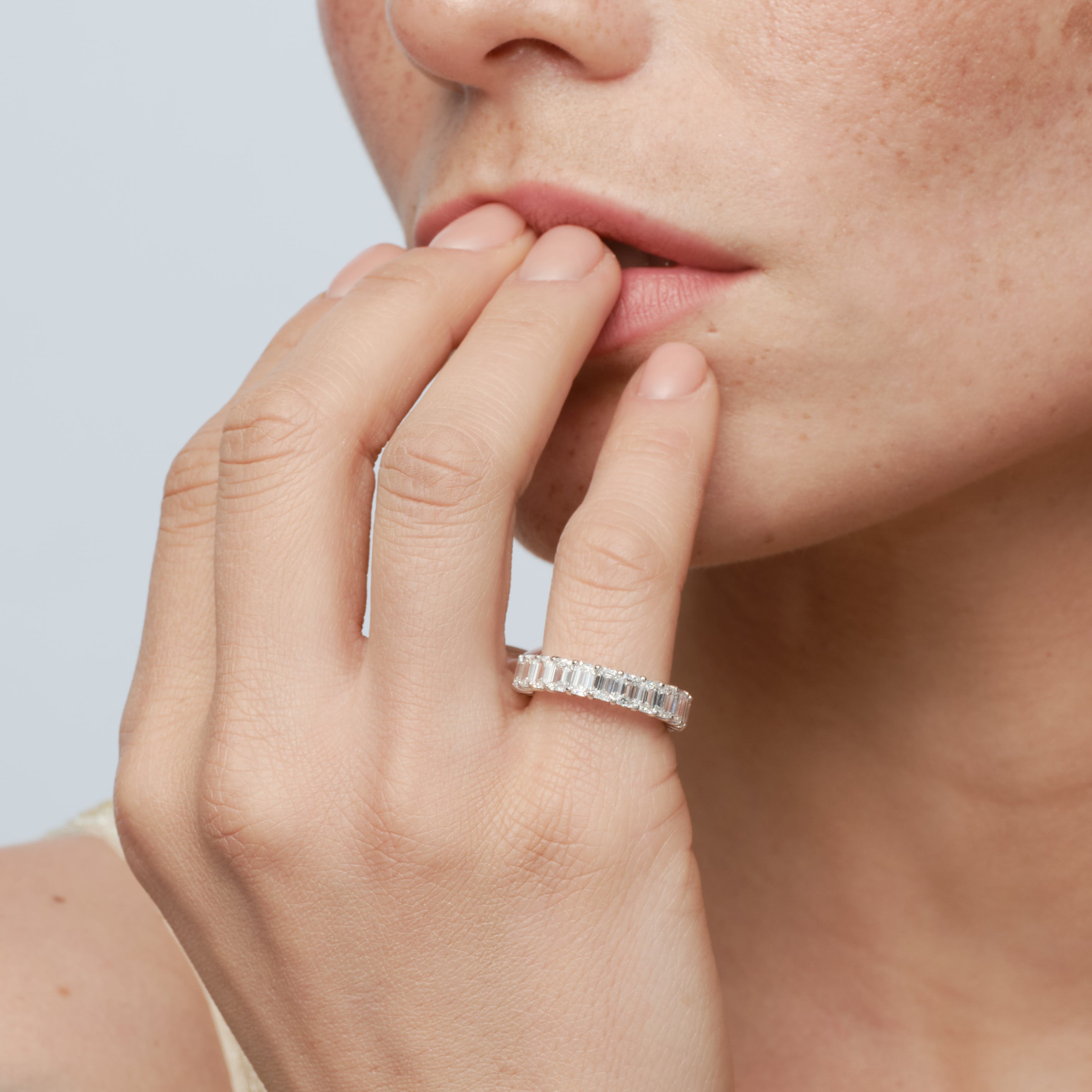
The emerald cut, with its 57 facets organized in rectangular steps rather than triangles and rhombuses, creates an optical effect known as the "hall of mirrors effect." Within the stone, repeating and deepening reflections are seen, giving a very characteristic sense of depth. It's not an explosion of light; it's slow, sophisticated elegance.
The baguette, with only 25 facets, takes this minimalism to its clearest version. It is frequently used as an accent diamond in pavé engagement rings or halo designs, precisely because its sobriety provides a perfect frame to enhance a central stone with greater presence.
The choice of cut is not just aesthetic; it's also a statement about what kind of light and character you want your diamond to have.
How cutting quality influences diamond facets
Having the correct number of facets is not enough if the cutting execution is poor. In gemology, cut quality is evaluated based on several parameters that go beyond simply counting faces:
- Symmetry: The facets must be perfectly aligned with each other. A slightly displaced facet can break the reflection pattern and create dark areas within the stone.
- Polish: Each facet must be polished to an almost perfect finish. Micro-scratches or surface irregularities scatter light instead of reflecting it cleanly.
- Overall proportions: The angles between the crown and the pavilion must be calibrated for total internal reflection to work correctly.
- Girdle thickness: The band that separates the crown from the pavilion. If it is too thin, the stone is fragile; if it is too thick, it adds weight without adding visible diameter.
All these factors are included in the gemological certificate that accompanies every quality diamond. At The Bright Club, all lab-grown diamonds come certified, ensuring that information on cut, symmetry, and polish is verifiable and transparent. If you want to delve deeper into what information this document precisely contains, you will find all the details in the guide on the diamond certificate.
Diamond facets and lab-grown diamonds
A common question is whether lab-grown diamonds have the same facets and the same optical behavior as natural diamonds. The answer is yes. Lab-grown diamonds are chemically, physically, and optically identical to natural ones: the same crystal structure, the same refractive index, and, once cut, the same facets with the same luminous result.
The difference lies in their origin, not their composition. A lab-grown diamond cut in a round brilliant with 57 perfect facets can sparkle just like a natural diamond if it has the same proportions and qualities. The cutter works the stone with the same instruments, the same angles, and the same precision, regardless of how the crystal was formed.
This is especially relevant for someone looking for, for example, solitaire diamond rings for a proposal: the visual presence of that central diamond depends almost entirely on the quality of its cut and its facets, not whether it formed underground or in a reactor.
Choosing the cut according to the type of sparkle you seek
Before choosing a diamond, it's worth asking yourself what kind of sparkle appeals to you most. There's no single right answer; it's a matter of taste and context.
- If you're looking for a lot of brilliance and scintillation, the round brilliant or princess cut are good options. Their facets are designed for the most immediate visual impact.
- If you prefer understated elegance and depth, the emerald or baguette offers that more discreet sophistication that fits very well with more classic or minimalist styles.
- If you want something in between, oval, cushion, or pear cuts combine a good level of sparkle with a more unique and distinctive silhouette.
- If you're interested in the halo effect, where a central diamond is surrounded by smaller stones, the contrast between cuts can be very effective: a round in the center and baguettes or pavé around it.
The choice of cut is as personal a decision as the setting design or the type of metal. What matters is that this choice is well-informed.
A diamond's facets are not a technical detail reserved for experts. They are the reason a stone can attract so much attention. Understanding them allows you to see diamonds with new eyes and choose with much more discernment. When you know what's behind the sparkle, you also better understand the value of the piece.

Gabriela Melguizo
Founding Partner & Brand Director
Learn more
Gemology, the science that gives value to every gemstone
There's a quiet discipline working behind the scenes every time someone buys a diamond, chooses an engagement ring, or invests in a piece of jewelry with real value. That discipline is gemology, an...
Read more
